Posts filed under "wordpress"
So I’m there minding my own business, just checking my feeds and I see a familiar sight. Manji was mentioned on Devlounge as one of the single column themes of choice.
That’s pretty cool actually, seeing as it was designed over 4 years ago and hasn’t really been modified since. What’s interesting to me really is that there does seem a severe lack of super simple themes out there. Super simple is fucking hard to do and make stick - but that’s a topic for another time, which I fully intend on exploring.
Oh and btw, this is officially Broken Kode’s 1500th post.
Earlier this month I moved this blog back over to WordPress in an act of madness. I hated it and did little blogging in that time. In considering why I hated the experience at WordPress so much, I came upon an interesting parallel. Habari is to WordPress what Apple is to Microsoft.
One of the things that can be said about Apple when compared to Microsoft is that Apple provides a more elegant computing experience that has been better thought out. In a similar fashion Habari is by far the more elegant product where the details have been sweated out and the experience has been better considered.
As a simple example when you install WP you get a random password in your email box and then the second you log into the panel you get a message asking you to change your password. Why didn’t you let me choose a password during the installation process?
Meanwhile on Habari, the installation is all done on the same page, you insert your preferred password right there.
As another example once you’ve logged into WordPress you’re bomobarded with this clusterfuck of items - TMI (too much information). Yes, i know you can remove most of that stuff (but this is all feeding into my analogy). These items aren’t necessary, they’re added first and you are asked to remove them. It’s like when you buy yourself a Dell PC and get a whole bunch of crapware installed on it, which you can remove (most of the time).
Habari doesn’t have that shit to begin with. These items have not been added from the outset. These things have been considered. And who else do we know that doesn’t like superflous stuff cluttering your view and generally getting in your way? These are just a couple of examples which I might expand upon, because the above is basically the tip of the iceberg.
These are subtle differences but important I think in the final assessment, afterall the devil is in the details.
After a moment of pure madness, I went back to WordPress, only to find that actually the creature comforts that I had become accustomed to in Habari were not present. It had such a detrimental effect on me that I could even post small links. The bookmarklets didn’t work, the thing felt heavy and I couldn’t wrap my head around the various elements of the code that had passed me by.
I’ll be writing more about Habari in the coming months as there definitely is a lot of work being done, but it just needs a bit of, consolidation of sorts.
If you’re reading this in your feed reader, then have a look at the site, which looks a little bit different, as I’ve also updated to version 9.
What’s the reason for going back to WordPress? Simply the plugins and documentation available to me to actually do what I need to get done. Yes I could called on the Habari community, but I just want to get on with things. Trying to write something like P2 for Habari is definitely out of my scope of knowledge. I’m not a developer. I’m not even a web designer. This is something of a hobby that I enjoy playing around with. But it should get in my way, and unfortunately due to my inadequacies as a developer Habari was getting in my way. I really really hope that in the future I’ll be able to make a proper and permenant jump over to Habari, but now is not the time (I did attempt it for a year, but my site looked more like it was created in 2006 rather than in 2009).
I am more than happy to play around with this and make it work for me, slowly moulding it and shaping it to what I want it to do, but writing this from scratch would be too much of a pain in my ass.
So here it is, comments are back online (for now) and I’m sure there is going to be a load more things to come in the not too distant future.
It’s been nearly 4 1/2 years since comments were officially not part of this site. Back then it was because I couldn’t actually host them on my own site, until of course I moved to WordPress and during the blogging revolution of the early naughties. So what’s changed? Twitter and Facebook. Both of which have brought the internet to the world that hid themselves from it, but they’ve practically killed the blogosphere, or at least how it used to operate.
The funny thing is turning them off was on the cards for a while now. I’ve noticed this downturn for about a year now (probably a few months before I even moved to Habari as my blogging engine of choice).
Does it upset me? I guess it’s a different kind of change. While sometimes I like twitter, there’s too much noise for me on there. Also the fact that everyone only speaks in soundbytes does annoy me. I can’t read people’s thoughts about things because they’re limited and effectively people’s voices on the internet are silenced.
In the meantime I’ll be here writing more than 140 characters and hopefully sharing some good links from around the net. If you want to comment on something, drop me an email or you know…send me reply on twitter (maybe I’ll even integrate that twitter reply thing that Michael is attempting at the moment).
Wordpress users get treated to a whole new administration panel…again. How long has it been since Happy Cog’s redesign (wasn’t that in March)? The design definitely has a ‘jack of all trades, but master of none’ feel to it - hardly what I’d call elegant.
Christian wrote a little post asking why the Habari community was snubbed in the recent Smashing Magazine 10 Weblog Engines Reviewed post.
Why was Habari not included in this list? Well it was included in an honourable list. Instead though they included Joomla and Drupal. All very good applications in their own right, but far too bloated to be considered weblog engines (they’re designed for bigger sites are they not?).
In any case, I feel that the reason why Habari wasn’t included in here is a collection of things, but it is telling. While I wouldn’t go so far and say that Smashing Magazine in the authority of the internet Zeitgeist, I will say that they generally put a lot of effort into their posts and do a certain amount of research, so their not so much dismisal but rather short billing is indicative of where Habari stands right now. The problem is that I don’t think that Habari, the community or software is to blame here; rather I feel it has something to do with the net landscape as we are right now.
You could say that Habari is still pretty young in it’s cycle, however it’s a HELL of a lot more developed than the bit of software called WordPress was when I started using it (version 0.6 I believe). Back then WordPress didn’t have ANY themes. The plugin library was in the single most infant state you could imagine (if you compare it to now). The less we talk about the interface the better (that ship is stll a rudderless pile of shit as they change it more for version 2.7 if the latest betas are to go by, and believe me I don’t care enough to go there anyway). I don’t think the reasons for the lack of credibility can be attributed to the software’s limitations, because if you’re looking for something to post a blog, and enhance your site with any one of the currently available plugins, Habari is a pretty solid foundation that is only moving forward, moving into the future, because honestly all of those other ones that are on the Smashing Magazine post feel like the past.
So what is missing? Blogs are now a standard part of the net landscape. Open source projects are a dime a dozen (hell that list isn’t exhaustive by any stretch of the imagination, since it doesn’t include Habari or Chryp, to name a couple). Blogs are not this new and exciting medium that they were 4 years ago. People know about them and have had one at some point in their lives, even the completely tech neophytes out there will have dabbled. The options to create something online are a lot larger than before.
The other thing is that Habari hasn’t had a catalyst that exploded the scene. There was no Moveable Type changing their license rubbish and now back again (or whatever). That was the push that WordPress needed, initially. Right now, work is being done on WordPress but honestly it feels more like a rudderless titanic. Then you’ve got Textpattern….seriously is the project still alive? A while back I heard of a Textpattern fork, not heard anything else about it since then, but then again I’ve not been actively seeking any information so they could have moved forward?
The thing is that to draw people in there has to be some form of marketing push. What I mean by that is the word of mouth about Habari really has to begin in full steam. The great thing is that people are starting to do this, slowly but surely. Michael is talking more about Habari, as is Owen and Chris. Remember those badges that lived on the side of blogs? Remember the ones for Firefox? The thing with those of course is that the actual image usually pretty distinctive. The firefox logo is extremely iconic. Something akin to this would help spread it out again. It could be a community push that al those actively running their sites on Habari should have the badge to wear proudly.
Clearly there are other things that need to be done, however as with the Habari motto, the word really needs to be spread in a number of ways which can only be a good thing for the software and the community.
After nearly 4 years running the Kode on WordPress, I’m making the jump and going to better pastures. The internet in general is not high on my priority list, however I love the Kode and want the best for it, WordPress has not been the best for it for many many moons, which is probably one of the many reasons that the site got a bit left by the wayside.
Expect a little bit of breakage, maybe even come back later for the new RSS feed (which I think will probably be http://brokenkode.com/atom/1), as I transition over to Habari. See you on the other side.
To the internet. So last week we were offline at casa Khaled. Yes, that’s right, no net access whatsoever. At first I’ve got to admit that I was REALLY angry. Not at anyone but at the situation itself. I mean seriously, my computer felt like it was neutered. I felt completely cut off from the world and all because as it turns out one of the cables coming into the house decided to collapse on itself. Maybe because it finally decided to give up the good fight because of the cold weather? Maybe it was because the workers outside moved it a fraction and it was to frail to deal with it, either way I was cut off.
This has happened before to be honest, however this one I was a bit more composed with the whole thing. I was actually able to deal with a few things that I’ve been meaning to deal with for a while; like do a bit of writing, do a little bit of drawing and generally do a couple of things that I’ve been meaning to do for a while. One thing I did miss was this site. I realised that I need this place for venting, something which i’ve been doing a lot less of in recent times. One of the main reasons I continued to blog was because I liked the cathartic process associated with brain dumping, because after all that ALL I’m doing here. Sometimes I rattled a few cages, sometimes I make a couple of people smile, so I think I’ve found that spark that I need to really start making the words on this site start coming alive. So as of tomorrow, you can expect a lot more ‘Kode action coming your way, daily even.
It’s also time I kicked WordPress like a bad habit. Seriously, this shit takes FOREVER to log in. Once you’re in it’s kind of OK, but honestly SLOW as a fat man in water. Some things in 2.5 are nice, but alas I’m thinking too damn little, too damn late, I guess I will write something about it at some point.
A lot of people have been asking me about what I think about the new WordPress admin that’s coming for version 2.4. No actually I am telling big fat porkie lies. No one has asked me what I think, but I’m not going to let that stop me. Lets talk the new WordPress admin shall we.
Swiped directly from the demo site that can be found at hyper123, this is what the glorious new WordPress admin in version 2.4 is starting to look like. I say starting to look like, because you can see that they’ve got a while to go in sorting out all the breakages everywhere. In fact by Matt’s own addmission, it’s only 10-20% complete, which is why they’ve decided to wait until March to release this version, because obviously they’re not there yet.
Now obviously i’ve got a slight bit of interest in what’s going on in the admin, simply because I (and others, whom I really shouldn’t speak for) gave a year’s worth of our free time (more or less) to the creation of a revamped admin panel for WordPress. The powers that be, (well Matt actually) didn’t like it, which is why it never got included into the core.
So nearly 2 YEARS after the efforts that we did on that particular project, we are now finally getting a new administration panel design. Others seem to have tried and failed as well (the likes of Brian and i believe some other Automattic employee, I’m not into the WP community since they went commercial). Is this the thing that Happy Cogs have produced? I’m not sure.
Obviously they’ve decided to go away from the colour scheme that was introduced due to the Shuttle project. What you think the blue that you see came from somewhere else? Yeah no. The other thing that has changed, so far, is the dashboard. Last thing that I can see is the comments now have a number at the top to tell you how many comments in moderation or whatever. Apart from that nothing to report really.
For my money however, this is really like putting a bandaid onto a broken leg. Seriously. It’s past the time for this. This would have been bloody relevant several years ago, not now. Now, well it’s completely outdated and anything less of a complete and utter redesign (and that includes rethinking how your menu structure actually works) if you want it to be something relevant, fresh, exciting and ultimately usable by the widest range of people….but in that case you might as well start from the beginning and building something truly new and exciting…oh wait we’re already doing that.
Well it’s been a bit too long coming, but I think I’ve found a theme that I can get to grips with relatively easily. I’m going to be hacking Depo Clean, adding parts of Fauna and some K2 in for good measure. I had a look at Sandbox and I’ve got to say that I was pretty turned off by the function.php file that they’ve added in there. It just makes the markup so much more difficult to understand at first glance which is what made me keep looking for alternatives that just did the job cleanly. In any case Depo Clean probably best resembles what I’m aiming for in the end anyway so it helps that I like the markup as well. The next time I do this I’ll be converting this markup into something that can be used with Habari.
Interesting developments over at Six Apart. Lets dig up some of the things I said back in the day about this shall we. For all those in the dark, MT was the defacto CMS you would choose if you were in the market to get yourself a blog with comments setup on your server back in 2003-2004. Of course what happened was the Six Apart crew got a bit greedy at the time and all this free effort by the community was kind of slapped in their collective faces when they introduced the updated version 3.0 which was built off the backs of the community and sold back to them. The original pricing scheme was a complete farce but they revised it when they got the unexpected (erm yeah) response.
What this did was move all those people who were originally using MT to convert to an alternative. Some went to Textpattern, most went to WordPress.
3 years on, SA are now doing what they should have done way back for version 3 and maybe have kept some form of dominance. Currently however I feel it’s far too little too late. Do I give a shit about MT? Not really. I’m not interested in remembering how to write templates using MT-Tags and other bullshit. I’m not interested in revisiting the past. I will say however that the admin looks nice, and it’s also very cool that the actual engine dealing with that is the same as the one dealing with the blog itself, so I’m definitely going to bring that up with the Habari folk.
Ah yes, Habari, whatever happened to that initiative you might ask? Loads have been happening in the background but nothing massive for me to personally talk about. I’m sure once I get some more free time I’ll return to more active contribution and discussion, but I’ll leave that post for another day.
So I’ve decided on the final design (after something like 19 iterations all of which I will show everyone in due course) but I feel some of the html that I have been using on my site is slightly out dated since to be honest I have definitely not been keeping track of the comings and goings of the wordpress software and a lot of that code was based on practices of version 1.5 and before.
So the question I pose to everyone is what is the most up to date theme that has super simple html markup and most importantly doesn’t try to do too much. What I mean by that is a theme that has not been designed with additional cruft to include for an admin options panel, hooks for widgets that fit within wordpress.com etc. I’m not looking for a mod like K2, although I’ll be sure to have a look at some of the things done on K2 for inspiration. I’m looking for something that I can use and modify myself. The look is completely irrelevant as I’ll be dumping the css file straight away anyway and starting fresh.
Any recommendations ?
I’m currently in Greece for a full 2 weeks. I’ve been looking forward to this break for well over a month now, hell I’ve been looking forward to this break for at least 3 months. I didn’t go anywhere during the summer period, which was probably the worst thing to do for my psyche to be honest. The summer was a very dark time for me with very little bright spots which was clearly reflected in my mood and how I dealt with those around me. Being a traditionally pretty patient person, I noticed myself getting more irate with things and situations that I would normally brush off, or at least see the funny side. Hasn’t been the case for at least 3 months now.
I guess I can attribute this to the situation in Lebanon which seriously hit me very hard. I can probably attribute it to work which has been very far from enjoyable these last few months, or I can attribute it to unfinished business from several areas that kept me down (my list of unfinished projects is pretty extensive). Needless to say, I need a break and a break I shall have. However I’m never happy until I’ve got things off my plate and I’ve been very good at not putting anything new on my plate but actually finishing those projects that I had opened/started/committed to first, after all I’m a finisher, not just an instigator.
Since it’s good to have a list I think I’ll make this list to remind myself what I have to look forward to in getting these monkeys off my back:
The site is nearly a year old now, and I’m still using Fauna, which has done the site proud but I’ve got a lot more in store for this site. The break in Greece is going to do wonders to the amount of writing I get done for the site. This time round however I’m going to be sure to stock up on the reviews and release them at a slower but regular pace. Expect a lot of European comics and some more indie revies (as that’s the majority of comics I have in Greece).
The other two websites that I have promised and have actually done most of the work on (ie all the artwork is complete) it’s just a matter of coding the damn things. These will be done once I get back from Greece, although I might get the urge and sort them out while I’m in Greece, who knows I’ve got two weeks to fill in.
Book’s been done, edited by hand and just needs those tweaks to be put into the file and thrown out to lulu. This is probably 1 day’s work or something like that so I think I might be doing something about this in the not too distant future. Just get another thing that I said I’d do off my plate.
This is an interesting one. For a while now I’ve been asked if people can buy prints with my artwork. It’s been in the back of my mind and I did it once, but to be honest it was a great deal of hassle and not enough benefit. So I might go away from the DIY route and use a service like Zazzle or something similar. If any one’s got any recommendations that can cater for Europe at reasonable prices I’m all ears.
I talked about this ages ago. Obviously life got in my way and I wasn’t really able to go forward with this one. It’s a very simple idea, which I’m going to elaborate on in a massive post in the coming days. Once I’ve done the design I’ll contact the souls that answered my call the last time. Don’t want to be wasting anyones time. Needless to say that the current Broken Kode redesign and believe it or not Crazyegg have both enabled me to have a clearer view as to what works and what doesn’t in the design of a site (once again more on this at a later stage down the road).
Also on a completely different note, I really need to get myself a laptop (any recommendations for small dinky laptops, like the Fujitsu Lifebook or a Vaio would be welcome) as I’m currently using my dad’s windowz install using an ADSL connection that might be a little difficult to sort out on Ubuntu and it’s seriously painful to get anything done (which isn’t helped by the fact that it’s a shitty CRT screen that’s got a tinge of purple going through,…nice), the ‘Kode has never looked this bad.
Seems like the pay for model didn’t work? Can’t really say why the guys over at 21 Degrees have gone the route of giving Symphony away, but having done this blogging thing for a while, I can’t help but remember distinctly the outrage the blogosphere went through when Six Apart went and made the free Moveable Type into a pay for model. This is interesting in that it’s really going in the completely opposite direction. First come out with a pay for model, then give it away. The cynical side of me thinks that this means they’re trying to get people to jump on the Symphony bandwagon and then slap the price tag back on it once people have developed and spread the word about it, and therefore made a connection with it and invested their time into the product because it’s ‘free’.

Don’t get me wrong I think it’s great to give it away (because it really is a beautiful system), however I couldn’t find anywhere on their site the license information about the terms and conditions to downloading and using Symphony 21, and more importantly why and where they think they’re going with this free model. What can I say, the guys are fighting a hard battle and if they want to win the blogger market, they’ve got to be transparent themselves, they’ve got to blog about their system themselves. They’ve got to keep their users informed.
You have to download an installer which is directly linked to your Symphony account (is this a legacy thing from when it wasn’t free?) and then have to go through the motions. I’m quietly wary about where this is all going to be honest with you, simply because we’ve kind of been down this road before and I decided that I wasn’t going to be putting my eggs in one basket that wasn’t open source so I wouldn’t be rammed again.
When it comes to doing things in WordPress, any idea I come up with has usually been implemented several times over, however I think (and I really hope someone has actually done this and I simply can’t find it) but the idea for this plugin came about after talking with several of my friends who ‘read’ the site. A number of them have actually complained that whenever they come to my site, they don’t understand what the hell it is I’m talking about. For example I’d say half of them are completely lost by mentioning WordPress.
Basically it’s a very simple idea, which makes me wonder that I can’t possibly be the first to voice my thoughts about it, and to be honest I can’t see the reason why it can’t be implemented by persons more talented at this than I am. Basically the idea is that you let the user take control of what he views or subscribes from your site. So the person comes to your site goes to a “user preference section” where they choose which categories they would like to subscribe to and then the front page shows posts only from those particular categories (latest being shown on top of course).
That way the user takes control of what they want to read.
In a similar fashion I know that WordPress allows you to subscribe to specific categories, but honestly I’m definitely not going to sit there and subscribe to the same site 15 times. It’s stupid. I’ve got like over 200 feeds I’ve subscribed to, that is most definitely not an option. The problem of course is that I don’t get the read all those 200 feeds as regularly as I would like to. In fact I don’t get to read them that often lately, which is why I’ve been so behind the times lately. The other problem is the fact that there is a lot of noise in them feeds that I have subscribed to. The issue is most definitely not in the actual feeds themselves, but if I could subscribe to 200 feeds and specify which topics actually interest me from this particular site then I think it would definitely make my reading experience much more concentrated and less noisey.
It’s all about making sure the type of information you are interested in gets delivered to you in the correct way. It’s an extension of the RSS feed. It’s no longer acceptable to just provide me with an RSS feed. I want to choose the categories I’d like to hear from you, or allow you to choose what you view when you visit my site. That way you’re guaranteed to read things that actually are of some interest to you.
Anyone up for writing a plugin for me? I’ll send you white chocolate.
I definitely noticed spamming coming through, which left me scratching my head (50 in like a few hours). I guess those spammers are seriously getting their ass kicked by Akismet, easily the only ESSENTIAL plugin you want to have as a blogger of any description. Damn, was it really that bad before this plugin? The answer I guess, it was worse, because there was no solution.
The last week has seen some movement on a couple of the open source projects I’ve been involved with in the past couple of years. I’ve already spoken about the first one but now I’m going to talk about the other project that I had such high hopes for which have been washed away and effectively thrown back into the faces of those that actually devoted their time into producing the goods, I am of course talking about Shuttle.
For those in the dark I’ll give a brief history of the WordPress Shuttle project. The idea first came to me after I had just finished my work on the Manji theme. I had so much fun collaborating with people online and producing something that could be used by other people (and thus giving back to the software that runs my site), that I really wanted to get back into the game straight away. I talked to Joshua and the Chris, both of whom I have the greatest amount of respect for, both of which were completely up for the project. By sheer luck Michael was having thoughts about this of his own as well. He was more than happy to join the team and in doing so brought Matt’s (Lead WordPress developer and Automattic head honcho) attention. The endeavour was now considered more than just hot air. In a very shrewd move Michael brought in Joen and thus the initial Shuttle team began work. Because a picture paints a thousand words, this is the screen shot of what we had to work with when we first started:
If you’re interested to see more, you can have a look at a Carthik’s screenshots for WordPress version 1.5.
We started work in earnest and the emails began flying between us. We were talking about everything and anything that came to our minds. We did research of all the existing blogging software tools (and the time those that hadn’t been released yet). We talked about usability, advanced users, novice users how things should work, how things should not work, what areas we should concentrate on. Seeing as we’re all bloggers we decided to give the call out to people to find out what they thought as well:
My initial thinking was heading towards something completely radical to what we had. Just strip the walls down and start implementing things in a completely different way. I don’t know if I can find the very initial mockups I started flirting with but you can check out the image set to show a lot of the initial design development. This is where working in a team is paramount. I remember Joen distinctly pointing out that the fundamental structure of WordPress was fine and that we shouldn’t be rocking the boat for the sake of it but rather finding what works and what doesn’t. Making things simple for the user. I’m completely paraphrasing probably a couple of weeks worth emails beings fired between the ENTIRE design team, which of course included Matt at every step of the way (we didn’t have a mailing list until Matt set one up for us). It was agreed that we wouldn’t move to anything radical unless we felt it served a specific purpose.
I should have seen the writing on the wall to be honest. As the design went forward Matt seemed to implement things he liked and not bother with things he didn’t. So the blue hues made it into the design, as did the pods on the side, but little else. To be fair to him at this stage we really hadn’t moved every single aspect forward as you see it in the final mock ups.
The days went by and action on Shuttle was sporadic at best. We’d go through these massive bursts of creativity and energy and information sharing. Every once in a while one of us would prod the team to get it’s finger out and continue with this project. You might think it should be easy but people have lives and many things to do get in the way and it’s not like any of us didn’t have other projects on at the time.
Lets make one thing clear here. I am a finisher. I complete the projects I’ve actively put my name down for. I’m not in the business of making a claim for something and not going through with it. I’ve proven this time and time again. Even when things get tough, even when it seems like it’s not even worth it, I will continue to plough forward even if it’s only me, with the hopes that those around me will feel good enough for them to contribute as and when they seem fit. Contributing to Open Source should never feel like a chore. It should be fun, it should be something you actually want to contribute towards.
So in a last attempt before I completely gave up on the project I dived into the designs. For two weeks straight I would come in from work and spend 4-5 hours implementing the designs. I tried hard to keep with EVERYTHING we’d discussed in the past. The dos and dont. I tried to find solutions to design aspects we hadn’t really covered. I’ve not had that massive creative burst of energy in years (and this was done on the back end of creating the FOFRedux redesigned UI). I tried taking into consideration things that although I didn’t agree with I had to make concessions to allow for.
A prime example is the dashboard. We were told not to go too far with this because lots of discussions were going on in the hackers mailing list and it would probably be the one place that we didn’t have much say in. This is all well and good, so I tried to come up with a solution I could at least stomach. It’s easily my least favourite page of the entire design.
Once the mock ups had been completed I left them with the rest of the team for comments to be put on the table for them to change whatever everyone felt worked and didn’t work. We then proceeded to discuss how we were going to implement the designs. Matt was NEVER truly forthcoming about how this was all going to be implemented. We discussed the issue further, but once again he was as elusive as ever. When a response finally came back I didn’t know how to react. Thankfully other members of the team did. The designs were not some chicken to pick and choose at what you like and what you don’t like. They present a certain level of uniformity across the pages. They follow a specific design thought, and a great deal of thought and attention to detail has gone into them.
After we talked about it a bit more, and we were promised by Matt that things would get incorporated into the WordPress core, however it would take some time and it was mainly to make sure that people didn’t get jarred with the changes in one go, this was a solution I could honestly live with. The design wouldn’t be hacked but implemented gradually. So I went forward and released the mockups because they were the culmination of our active involvement in the project as things would now begin to get integrated into the core code. Of course things would change or be tweaked as the design was implemented but by and large it would remain the same.
Any which way you cut it that’s why Shuttle never made it into the design of WordPress. It has nothing to do with us being lazy or that we couldn’t be bothered to do anything but the photoshop files. Joshua had begun implementing the design on his own machine, we were discussing the logistics of how this project would be implemented into the code. However as it turns out there doesn’t seem like there was/is any commitment from the WordPress Dev team to incorporate these designs. If there was a commitment it would take 3 guys 4 weeks TOPS to deal with it all. There are well over 100,000 WordPress users, many of which are pretty capable with both CSS/PHP/JS. Hell there are people out there that are already implementing this off their own backs.
It doesn’t seem like the WordPress development team (and by definition Automattic team) are keeping to their word because the latest addition to the Automattic team is now going back to square one to start over, asking people the same questions we did when we first started the project.
Bryan joined the shuttle team late in the game and in some ways I think he didn’t feel as comfortable jumping into the design. He’s a fine addition to the Automattic team, and more importantly I like the guy, so none of this is aimed at him. He has been given new directions by the powers that be. Strip it down, build it up again from the ground if we have to. Why is it called Shuttle:Atlantis? Maybe because Matt didn’t like the first one? That’s what it boils down to to be honest. The alarm bells started going off when I read the first things to come from Bryan over of the WordPress.com blog.
… see that Shuttle finally makes its debut in whatever form we as a team see fit.
So I’d like to address those that didn’t like the Shuttle mockups. You (the collective you) got 5 people (plus 1) devoting a massive amount of their time to make your blogging experience more enjoyable; more usable; more fun. We didn’t ask for compensation and we didn’t ask for anything in return. We didn’t rush into this and we certainly didn’t hack through the designs. We did this because we believed in the sotfware. We believed in the people behind it and the people using it. None of us on the team are new to open source contribution. Michael’s contribution doesn’t need much introduction (Kubrick and K2), similarly with Chris (whose contributions extend far into the past of WordPress, Persian, plugins galore, K2), Joen does this for a living and has contributed for the admin panel on Zenphoto (including the default theme) and his wordpress theme Fauna. I have given the open source world Manji & Rin and contributed in the redesign of the FOFRedux UI. Joshua has answered enough support questions to make my head dizzy. Bryan has contributed to the world ChaoticSoul.
Open source is great because you can contribute to the source in a positive way, otherwise none of us would be actively giving to it so freely. That however is not the universal truth. At least that doesn’t seem to be the case in the WordPress world. This is a shame because part of WordPress’s success is the people involved with the world it surrounds. I have said many times before that is one of the things that elevates it above other open source initiatives.
It’s a shame really. Has WordPress really gotten so big that those in charge of implementing it no longer care for those that devote their time? As long as you’re creating a theme or a plugin that’s great, just don’t even bother thinking about contributing to the final product in any way. That kind of contribution is obviously not welcomed. There was a time when the Shuttle mockups, created exclusively for making WordPress prettier, would have been taken in with grateful arms. It seems that time for WordPress has passed.
Compare the current admin panel with those presented in the Shuttle mockups. Once you’ve done that go back to the top and compare it with Version 1.5.


Do you see something different. One was designed and thought through. The other is an ad hoc implementation of core ideas. I could go on at length to discuss the design decisions to be honest with you however I tend to allow the work speak for itself.
Ultimately I’m extremely proud of the work we did in TRYING to make the WordPress admin a better looking more usable place. The online friendships I’ve forged with the Shuttle team are thanks enough, even though the work we did was ultimately not appreciated. This is probably the very last time that I talk about Shuttle, unless of course someone implements the design aspects of the work we created as a plugin or in another way.
When the Shuttle images design were released for general consumption I expected a great number of people to jump on board and help out Matt in the implementation of the code. Now I’m not sure how far the WordPress team have got with version 2.1, as I’ve heard some little bits and pieces over the last week or so with Ryan doing what he does best.
However I’d like to point out Mark over at the Sidejob, who’s actually taken the images and made them a reality on his install. This is the sort of thing I like to see. WordPress is a community EFFORT. Not so keen on the yellow background but we can work with that :).
Been meaning to write a proper review about this book for a good long while. Due to many commitments it’s not been possible to really get into the book until now. “Blog Design Solutions” is a book that was released earlier this year (from Friends Of Ed) and was written by 8 guys from around the world; you might recognise a couple of the wee rascles, Chris J Davis, Michael Heilemann, John Oxton, Andy Budd and several others (I appologise I’m not terribly familiar with their work/sites but I’m definitely going to check them out from now on). The common link between these gents is that they’re all bloggers. The difference is that they use different software to run their sites.
There are numerous sites around the place that highlight the differences between the major blogging software packages available to run your blog sites on. What this book does is give a taster, a morsel, a sampler of the major ones. The book is seperated into 7 Chapters. The first two chapters cover general information about blogging and the world of blogging. While the second chapter tackles how to set things up to test and run a blog on you machine locally. It’s a nice reference guide to have to be honest. I personnally use XAMMP, but it would be good at some point when I’ve got a bit more time to set things up in a less lazy manner :).
The next 5 chapters are where things get interesting. Each chapter addresses the ins and outs of a particular blogging engine. Movable Type, WordPress, Expression Engine, TextPattern are all covered. The final chapter is very interesting because it tackles the subject of building your own blogging engine from scratch and how you go about it.
Movable Type is covered (including the history that Mena probably tends to like to forget, ie when MT3.0 was released and there was this massive jump away from the MT solution to the WordPress solution). I was intrigued to read this chapter because honestly I think to myself what the hell is the point of using MT? It seems to me like it’s lagging behind most of the other internet blogging solutions? The answer to two fold I guess. Part of it is the fact that it’s pretty old (in internet terms) and has a loyal base of users; in addition to that it’s also the fact that there is a core base of developers that are accountable to you if in case you want something done, or sorted out. Some users want that level of support, especially if we’re talking about commercial corporate users of some description.
The WordPress chapter is special to me, because it’s the WordPress chapter (in case you didn’t realise the ‘Kode currently runs on WordPress) but more importantly it was written by my two buddies Michael and Chris, so obviously I’ll be paying more attention to this chapter than the rest of the book (hey at least I’m honest about these things). So how did the boys do? Not too bad. What’s great about this particular chapter is that their characters come throughout the entire chapter. Blogging is about interating and reading other people’s thoughts. It’s about communication and expression. They’re the only guys that spend a bit of time telling you about themselves and what their knowledge levels are. It’s a great way to ease the user into a comfort zone. Michael (at the time) was still struggling with php (no problems now I’m sure as he’s decided to take on JS as well), to prove that you didn’t need to know PHP coding in order to design and play around with WP, all you need is the drive, patience and some time.
I’ve got to admit though that the most interesting chapter for me was the final chapter by Richard Rutter. Which walks you through the process of making your own blogging engine. Why is that interesting to me when someone else has already done most (if not all the hard work for me). To be honest it would just be fun to have everything running on something I designed and coded. The thing of course is that I’m not a coder and therefore won’t realistically be able to do something like that. Also the first thing that comes to my mind is how I don’t think I’d be able to deal with Spammers. I can’t do without Akismet to be honest and I don’t understand how other people can manage without this plugin.
The book targets 2 groups of people, those that want to start off blogging and what they’ll need to know; the second group of people are those that have passed that stage and would like to learn how to customising their blogs, and what to look out for. I don’t think I’m really the core target audience, but even I found several nuggets that were really worthwhile. It’s definitely a book I’d recommend giving to the newbie who’s interested but is also a bit overwhelmed by it all, because this book holds his hand in style. For the hardened blogger the book is interesting as an overview of other technologies so as to keep abreast of what’s going on, with a couple of areas that are definitely of interest, but then again that’s not who the book is targeted at, so it’s nice that the editor made sure there was something for that group of people as well.
I’m going to ramble on a bit more about Shuttle, simply because it’s been a pretty big part of my life the last year and loads of things I’ve wanted to talk about on this blog have been waiting for this moment in time. Everytime I would think about something cool to talk about relating this project I always had to keep on the mental shelf until after I got to this stage.
The problem however with this situation is that INSTANTLY people’s expectations were raised. Some people were expecting the second coming and didn’t get it. To be fair though we never promised you the second coming. We promised we’d do our best to make the WordPress admin beautiful and usable to people of all levels of experience with the programme. Some might forget that we’re not catering just to the power users; we’re catering to the every users. That’s a tough thing to do correctly, and that’s part of why it took as long as it did… but only a small part.
Of course then there are those that feel that the admin didn’t really need to change at all. I obviously disagree with this assessment COMPLETELY, otherwise I wouldn’t have gone down this road in the first place. However this is a VERY important comment to take note of. You see change is feared by a great deal of people. In fact that’s probably (amongst many other reasons) by Matt will be implementing the design incrementally. WordPress got to it’s current popularity based on the fact that the software does what it does, well. Add to that list the community behind it; and finally the simplicity of the UI design.
The Shuttle team obviously saw room for improvement as we belive it’s not the prettiest to look at. Some might then argue and say:
Well hang on, it does the job right?
That there is a programmer’s mentality, not a designer’s. So right from the very start (I remember clearly) Joen tried to push the idea that the overall structure that the interface currently has is not incorrect fundamentally and therefore we shouldn’t be looking to change that just for the sake of it. Michael then kept hammering the ideas (through his comps) that if it’s not needed STRIP IT OUT, keep it simple, keep it clean, keep it clear. On the flip side we had Matt telling us some seriously weird things you guys do when using WordPress so we had to factor a bit of that weirdness in there as well. However don’t try and deviate from what has been established as a core unless there’s a serious reason. Those reasons would then get hammered back and forth, between Denmark, England and the US on a regular basis.
For those that are thinking that this is just a design exercise and won’t get included fast enough, I think you’ll find that if you’re running WordPress 2.0 the integration of Shuttle has already begun! What you think Matt woke up one morning and decided to add the colour blue from the previous grey? Or that those drop-down-draggable menus in the write section appeared on their own? All things that came about from the Shuttle project. Admittedly they’re not as we mocked them up at the time, however we hadn’t progressed to the level we are now at the time those areas were being implemented in the code. I now officially feel like Morpheus in the Matrix after Neo gets his ass whupped in Kung Fu.
Many lessons were learnt during this design process however we’ll keep it at this for now.
To avoid any confusion and answer some questions that have been raised I’ve created this small FAQ (Frequently Asked Questions) to dispell any rumours and set the record as straight as I possibly can. If you’ve got any questions put them underneath and I’ll update the post accordingly.
When we first set out, I had tried to contact Matt regarding the idea, but he never got back to me. Uneffected I spread the word and with the inclusion of Michael to the team, Matt got back to us; originally he thought this was a fork, it wasn’t. After a bit of emailing we got Matt on board and he oversaw all the development that went into the mockups that you see. When it came down to how this design would be implemented there were several ideas thrown out into the ether, including creating a plugin.
However after much back and forth it was decided that this design would be better implemented as part of the core WP install. In many ways it was also impossible to implement this design in any way apart from altering the core code, so a plugin was not an option.
If Matt needs any help or wants some clarity on how certain parts of the design should work the Shuttle team is ready and waiting.
If a whizz however feels that they can use the core WP admin files and implement the design, PLEASE contact me and I’ll be sure to give you EVERYTHING you need (spliced psds, colours, dimensions etc, hell I’ll even setup an SVN for you as well. However I feel that this won’t be possible and as such we’re all going to have to wait for Matt and his excellent team to get on with the task. Patience is a virtue.
Nope. We’ve not written any code. Actually that’s a lie. Joshua began coding a plugin when it seemed fuzzy as to what Matt was planning on doing with the design. However since we got a firm commitment to the implementation of the mockups as you see them that sort of stopped. The issue was always how we would implement these changes and keep up with the daily changes that happen to WordPress from the dev team.
I sure fucking hope so. The Shuttle team was fighting over pixel placements, colour hues and the list goes on. There will be certain areas that might not work out exactly, as the internal discussion between the hackers list continues (specifically about the dashboard), amongst other things. However when it comes to the aesthetics Matt will hopefully contact us regarding how to implement areas before making final decision on the outcome.
The design. We set out to make the WordPress admin both more usable and more beautiful to look at. We feel that the mockups (if implemented as shown) will elevate WordPress high and above the rest of the blogging and CMS systems available on the net currently. This is a very important step. We’ve learnt a great deal in the process and it’s time we actually were more open about the results, after all it’s called Open Source.
The idea of redesigning the WordPress administration panel began believe it or not in December 2004. For over a year and a half myself, Michael Heilemann, Joen Asmussen, Chris J Davis, Joshua Sigar (later joined by Bryan Veloso) exchanged countless emails and mockups and links and ideas regarding what we thought the WordPress administration panel should be. The project was called the Shuttle Project. I now have the pleasure of presenting what we came up with and explaining the future of the project. The Shuttle project was without a doubt the single hardest thing I’ve ever been involved with. The only thing that made it easy for me was the fine and exceptional gentlemen on the Shuttle team itself. What made it so difficult is the fact that we were thinking of the thousands of WordPress users all over the world. We were thinking of usability, we were thinking of asthetics, we were thinking of the power user and the novice user. How do you get three headstrong (and passionate) designers to play nice with each other? I swear I have no idea but somehow it all actually worked out in the end. I owe Michael and Joen a great deal of thanks for helping me improve how I think about design.
However the greatest thing that I could have gotten from this project is the sense of collaboration that I felt throughout the project. We were all working towards making something we use on a daily basis that much better, it makes Open Source that much more enjoyable. Although it was tough going through this design process, I think we’ll all instantly forget everything once it’s part of the official install.
Matt Mullenweg (lead developer of WordPress) will be incorporating these mockups into the official WordPress releases in due course. I don’t know when he’s going to be getting round to implementing the code for it all, so if you’re willing to help out to move the process along, by all means feel free to contact him and offer your assistance. This will not be a plugin.
I can’t wait for the Shuttle designs to be incorporated into the WordPress install, as I do believe that once it’s done there will be only one choice in which platform you should be using.
There are some serious changes to the architecture of the panel as we see it, and I (and the rest of the Shuttle team) will be going through the decisions we made and the reasons behind them in due course. The first element I think I’ll talk about is the choice of colours. When the project first began, the WordPress administration was a drab grey. It included a nice big gradient along the top of the navigation bar.

So the first major change we made was give WordPress a colour and it’s own distinct identity. We had to make sure that it didn’t mimic any of the other blogging tools out there, so we did a bit of research first. Textpattern has orange, Symphony is green, Moveable Type is grey/green, Expresion Engine is purple. We decided to go for blue. What does blue signify you ask? An easy link (and direct from Wikipedia) is that the colour blue:
…is considered a calming, soothing colour, perhaps related to its association with water and to the sky.
That was what I was hoping we’d get. The colour palette provides an atmosphere that is familiar and not harsh on the eyes. Seeing as a lot of people spend a great deal of time looking at the actual backend of WordPress a great deal throughout the day, it was very important to keep the visual impact of the administration panel to a minimum.
After a great deal of back and forth and loads of mockups and discussion the number of hues of blue was kept to a total of 3. These same blues would be used to distinguish links within the panel itself, as consistency is a major factor in keeping the user comfortable.
One idea that I really loved, however it didn’t really fit in with the overall design was the error and sucess system messages. The original intent was that an error or warning would be given a red colour while a successful message be given a green colour. This would provide a great visual aid, and users would instantly know if something was wrong or right. However we decided that the light blue and yellow coloured icons could provide the same level of visual information with the addition that they tie into the design itself which is what we were here for in the first place.
Join me next time as I talk a bit about usability (or at least try and talk about the subject).

Update: The smaller images now click onto LARGER versions for your viewing pleasure.
For the past year the Shuttle team has been working on the beautification of the WordPress administration panel. The original team was just going to be myself and a couple of coders (Chris and Joshua) who were going to take the designs I came up with and make into a reality. Luckily Michael was having the same thoughts at the time and so he joined our rag tag team. In a cunning move he brought in the inimitable Joen to the fold as well. So now we had enthusiasm (me), flair (Michael) and experience (Joen) along with Chris and Joshua ready to kick some coding ass and take names. That young upstart Veloso joined us half way through the year to add some insight and youthfulness. Matt caught a whiff of this and though we were forking, which obviously we’d never dream of. So we invited him to oversee where we were going with all of this. Meanwhile Steve was working on his Tiger admin panel half way through our design, and as you can imagine the stakes got raised ever so slightly. Unphased we continued to plow through. Email after email, mockup after mockup.
Version 2.0 was released and the first signs of the work we’d done on Shuttle began to appear. No they weren’t exactly how we mocked them up to be honest (you can blame us for the blue colours and the collapsable tabs on the side though). A year is a long time and we were pretty determinded to finish this off by the end of January. We blew that deadline, but the desire was still there.
As of today we’ve officially completed Wave One of the Shuttle project. I effectively took all the work we’d done so far, all the things we’d talked about and tried to come up with a cohesive solution. Just hammering page after page. I’m not really sure were it all came from, but I guess it was mainly due to the fact that we’d sat on this for so long that is was time we just dealt with it all.
Here are a couple of images for you to have a look. I’m working on a mini-site to show all the work done so far.
Just to stress a few things, these ARE NOT THE FINAL mockups. I have changed a great deal since our last working mockups. The boys now have the psds and will hopefully be tweaking and doing their magic to try and pull everything together. How much of this makes it into the final WordPress install is really dependant on Matt. The boys and I will be talking at length about our design decisions in the near future; we’ve got enough emails to troll through to find hot contested parts etc.
So for all those wondering about the status of this project, that’s where we are right now. I for one see this as a HUGE milestone since we’ve been working on this for over a year now and it’s good to find some form of closure. I know it’s never really over, but at least I believe it’s a step in the right direction.
This posts marks my 500th post for this little site. In the comic book industry this number is a massive one that only a handful of titles have ever achieved. Although not even close to that sort of achievement, it’s nice to attain this milestone in the life of a website, that was only meant to be as an easy method to update the news section of my portfolio site.
The site was originally set up to chronicle the road to getting published in the comic book industry. which is kind of fitting that I can recount the following story at this time: One of the traditions on a lazy Sunday for me is to go around 3 o’clock to the local newsstand and check out the different design magazines and what not. I’ve not renewed my subscription to Computer Arts, mainly because of the old editor-in-chief who in my view ruined the magazine. I’ll be checking out the magazine now that someone else seems to be at the helm. So I’m checking what’s on offer, and I picked up Practical Web Design. I’ve never picked up this magazine in my life, as I generally tend to gravitate towards Computer Arts, Digit, Digital Creative and Creative Review.
So I started flicking through the magazine, and I get to a featured called ‘Build Quick CSS Templates’. The double page spread had several websites screen shots repeated a few times throughout both pages. As I started looking through the page for inspiration I noticed something very familiar. You can imagine the little girly scream I let out when I saw Broken Kode in there as well! My humble little site has seen print as well now.
Joen, you’ll be pleased to know that Noscope was featured in there as well. Could the guilty party who gave us this little bit of exposure PLEASE STAND UP :).
I always complete my projects. The only problem is that I generally take a little longer than I’d like to, but my problem is that I have too many ideas and not enough time in the day to get around to giving these projects their proper time. As I’m not really happy doing a half-assed job on something they take a bit longer than usual.
I’ll be doing my next workshop post in the coming week to discuss the plugins section. Things have slowed down again on that front, but it goes through dribs and drabs. Nothing to worry about. It’ll take as long as it takes and will be great when it’s done.
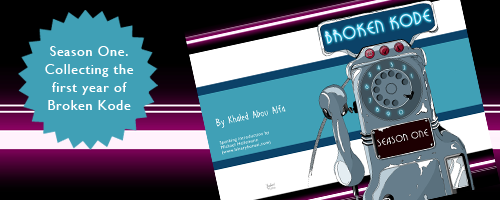
Yeah like I was going to forget this little project. Hardly. This weekend I spent a good portion of it formating the first year of posts into a book. I’ve got a lot of ideas for this one to make it special, but I don’t want to talk about it in too much detail now as I want to keep it for when the book is complete and at Lulu. I’ve enjoyed creating the look of this book as anything else I’ve worked on in the past year. Within one day I’ve been able to go from a 100 page open office file, to 300 pages of formatted pdf goodness. If I get everything done correctly then Season One will be much more than a Blook. I will enter it for consideration into the Blooker Prize. The biggest buzz for me will be having a book in my dirty little hands with my name on the spine.
What’s been interesting is going through and spell checking everything. My god there are some serious errors in there. I’ve not changed any words in there, just corrected the spelling. There’s a reason for that as well, which will make the final product very different and more than just a collection of blog posts.
You thought I’d forgotten hadn’t you? For all those in the dark, I mentioned a while ago that I was interested in doing a WordPress Portal. Well now it’s a Blogging Portal. I will hopefully be talking more about this sometime later this week. It will be something focused on the community and while the start of it will be closed to a select number of people, I want to make sure people understand that the portal will be open for everyone and will have a focus on the end user rather than a specific product/tool etc.
The best thing I’ve gotten from the 9rules network isn’t the exposure. Sure I’ve gotten some steady exposure from there, however the best thing is the interaction with the other members of the network. I’ve met some seriously cool people, many of which which I’ll be working with in the coming years for sure. I’m hoping that this portal will be able to bring people closer together and enhance their blogging experience.
Well this one I’ve actually told absolutely no one about except obviously the person that’s my partner in crime, one AvalonSTAR. Still very early days, and I don’t want to mouth off before we’re a bit more into this project. It’s a slow burner but I’m extremely excited about it. Think outside the box.